
Prosthetic
Considering the momentum-ous nonlinear platformer, Derelict Star.
This piece discusses the nonlinear platformer Derelict Star (2026) in mostly-abstract terms. Still, the game is available for $9.99 on Steam and itch.io; as a great deal of its appeal resides in the individuated mechanical epiphanies which have been constructed carefully for the discerning player to intuit-conceptualize-enact, this is the kind of game which should be played before reading any secondhand commentary.
Derelict Star is a platforming game about lonely inertia and epiphanic momentum. Its faceless protagonist explores within the confines of a scarlet spacesuit which is not just stubborn to changes in its state of movement but at the behest of a huge variety of velocities. This in contrast to a more dominant mode of two-dimensional platformery, that is.
Reductively, let’s suppose that there’s a spectrum of modeled movement in this genre which corresponds to the degree of corrective control a player has over direction and speed, with, let’s say, MOMENTUM on one end, and, on the other, PRECISION. For some time, the developers and playerbase of such games have gravitated towards the pixel-perfection of the latter (which we’ll take to be the absence of the former), exemplified by the likes of masocore freeware titles such as I Wanna Be The Guy, but even more evident in the core appeal of lauded indie commercial releases like VVVVVV (2010), Super Meat Boy (2010), or Celeste (2018). These games are loved not despite but because their levels have been constructed within the context of the onscreen position having a near-exact relationship with its off-screen button-presses; latency, in its technical sense but also in the general valence–of how much time exists between a cause and a response–is intentionally kept extremely low, if not entirely unnoticeable. Mastery in this kind of platformer is largely reaction-dependent, obstacle-avoidant, and, at its worst, repetitive. At their best, such games become more metatextually about toying with masochistic psychology, a gamification-riposte of the definition of insanity, by which a genuinely empathetic dialogue between designer and player forms out of their shared interest in the repetitious execution of an increasingly meticulous series of inputs under increasingly harsh failure conditions.
With respect for self-hatred & precision alike, I’ve for some time adhered to a different creed of interactive movement. Games about movement strike me as emphatically more interesting when the simplest premise–jump over this pit so as to land upon this rather small, floating block–is itself not just more difficult, but prone to a nonlinear curve of input fuck-ups. Failures often enrich in proportion to their own variety, after all. On the one hand, it is easy to see why such moment-ous games, which are both overtly awkward and in a very definite sense seek to limit the player’s control, have become the more niche of the two; on the other, the foundational text here is literally Super Mario World. I’ve already alluded to his line of thinking in the second sentence of this paragraph, so here’s Raigan Burns, one-half of Metanet Software (with Mare Sheppard), talking about SMW; in N++ (2015), they created not just my favorite game, but a definitive elevation of Nintendo’s own gold standard of floaty, variable, playful movement:
“With momentum the player’s brain ends up living more in the future: you have to anticipate the state of the world because if you only react, then the latency due to movement means you’ll always be late. This sort of ‘imagine-the-future-state-of-the-world’ adds a ton of flavor to the gameplay, because it makes moving the character a minigame, sort of like throwing and catching a ball: you have to anticipate things, and get an intuitive feel for how you’ll slide…[momentum] makes more of the magic occur in your brain, and less in the computer, on the screen. It’s all about the anticipation. It’s kind of like proprioception: you know where your limbs are even if you can’t see them. It’s like a digital prosthetic. There’s this character you’re controlling, but it’s kind of becoming part of your body…I never liked Mega Man or Metroid or anything where the movement is just lines. It just doesn’t feel nice, is one aspect, but the other aspect is: it’s boring…I feel like calling a bunch of games ‘platformers’ is about as useful as saying ‘guitar music.’ It could be Flamenco, or it could be Nine Inch Nails.” (TSLOG Podcast, SMW episode, February 2022)
There is of course a great deal of precision involved with momentum-based platforming and vice versa–Trent Reznor got an Oscar for his New Age-y jazz Pixar score, after all. The more interesting suggestion is that combinations of input-output relationships which are delayed or otherwise defamiliarized tend to allow the body-mind to marionette in-game avatars in a way that is closer to how it already interfaces with reality: imperfectly. No accident that the “real” tactile instruments to which my brain has become more automatic, to which it has extended itself through the creation of robust neural pathways–piano keys, bicycle pedals, Pilot G2 1.0mm gel pens in blue–are objects which create resistance & padding on the way to muscular expression. Motor learning becomes absent in proportion to the instantaneity of record, which is (in part) why we can’t remember the ordering of emails or short-form videos thumb-flicked past effortlessly, but can often point to the specific place on a yellowing page where a sentence or paragraph was read minutes or hours ago–why we have such unflinching memories of our oldest computer games, for which the controls might be called “tanky,” “floaty,” or, tragically, ”bad.” Concepts of game transfer phenomena (the “tetris effect” whereby game-specific phenomena bleed into reality) or the “phantom limb” effect (which affects nearly all amputees) each suggest that the relationship between a mind and the instruments of its perception and sensation is not just conditional, mediated, and fraught, but equivalently bound up in instruments that have ceased to be literally “real” at all. Observable logic, then, to the fact that routing in platforming levels becomes a great deal more improvisational, playful, and prone to edge-case disasters–prone to greater mind-bodily inhabitance, even–when there exists a greater delay between an idea and its expression. In Super Mario terms, once you’ve realized you need to have started running towards that platform a bit earlier, it’s already too late.
The appeal of Derelict Star is that it takes this philosophy, applies it to the kind of hub-and-spoke, graph-paper world model that we’d more traditionally find in that most-peskily-titled subgenre of nonlinear platforming–which typically enables and controls exploration by drip-feeding movement upgrades to the player–and then never once gives the player any movement upgrades. You begin and end the game with a small jetpack affixed to your suit which grants a few fleeting seconds of momentum-dependent parabolic coverage. The best moment in Derelict Star is a thirteen-way tie between all occasions in which you have to experiment within the constraints of your basic toolkit in a completely new way, to access a new spoke of the hub.
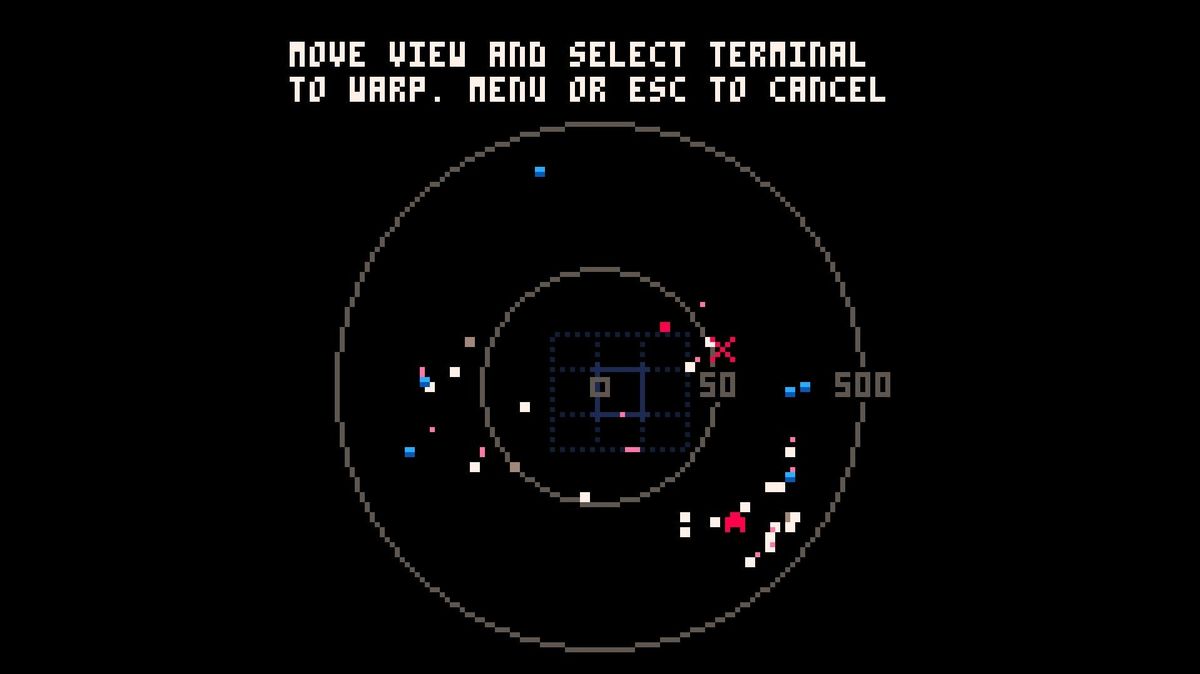
In narrative terms: you’re not Samus, Alucard, or Hornet. You are merely in the relatable position of having already made a mistake; less heroic, more human. The operative word in the game’s title is not the place where you’re stuck but its status as abandoned: by its owners, by its occupants. Perhaps it’s a common enough danger in this distant, lonely future, simply their version of a car dying in the middle of the Mojave. And rather than jumpstarting-to-driving, we would now like to fold, a la Sam Neill’s pencil-piercing-folded-paper explanation of wormholes in Event Horizon (1997). Tragically, folding costs fuel. A properly hands-off tutorial has you use your remaining power to fold once, ending up, titularly, at the derelict freighter-class vessel 4.7 lightyears–over 40 trillion kilometers–away from civilization, the one place which has, per the terminal, a “50% chance to contain stable power cells that can be trivially altered for use in this ship.” In gamier terms: progress is made of power cells. Find nine of them, in any order.
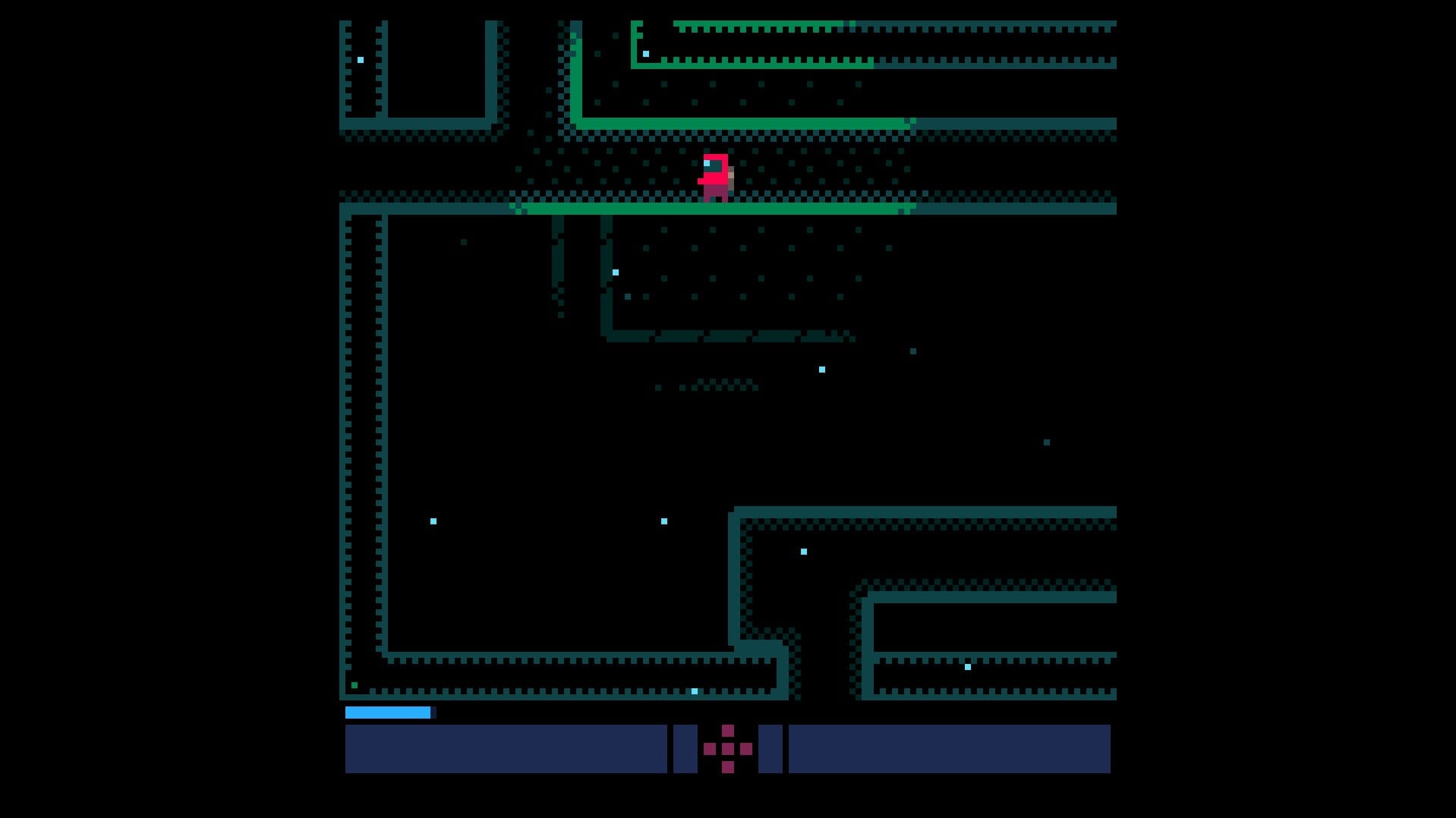
To limit further fingerprints on the glass here, let’s consider just two of them in the abstract. Our to-be-scavenged vessel in question is a good deal lonelier than a Ceres Space Colony or Sevastopol, an Ishimura or Talos I. What little biological flora or mechanical fauna exists is largely as indifferent to visitors as would be the wind-swept ammonia storms on Saturn; the invaluable power cells which were sequestered by whatever corporation built the gargantuan ship have, in every case, been left behind by them for good reason. One is tucked past a shattered nuclear reactor; another down-and-around a deep pit of adhesive green slime which is sprouting turquoise fungi. Back in reality this game's freighter was built in Godot, but it was initially prototyped in PICO-8, and that engine’s 128x128 resolution has been preserved to gloriously minimalist effect. Obvious dictum: necessary imagination on the part of the player decreases in proportion with graphical fidelity. Actual joy: with fewer than 17,000 pixels on-screen at any given moment, each of them only ever one of sixteen colors on a fixed palette, it might not be immediately clear that the motes which cling to you en route through the black ventilation ducts are actually deadly particles of radiation, or that the adhesion of the slime might be as useful as it is limiting.
These delicious ambiguities and narrative inferences are only possible due to visual constraints, but even without as much affection for such environmental storytelling–perhaps that shattered reactor has a lot to do with the ice up top, or the fungal mess down below?–the PICO-8 aesthetic is perfect for a game about momentum. (And, given the early PICO-8 development of Celeste, likewise for those platformers about what I've been calling precision.) Our developer, gate, comments:
“The basic idea was to make a game that makes somewhat advanced Super Mario World controls more ‘intuitive’ to learn. In SMW, holding the jump button in midair makes you fall more slowly, so I gave the protagonist a jetpack to sell that idea with a visual metaphor…I found these visuals were a really nice way to provide an observant player clarity on subtle platforming mechanics, so I ended up polishing those up and keeping that ‘debug’ display at the bottom of the screen to act as your spacesuit’s UI. (via Insert Credit)
The real talent of Derelict Star is that its run-meter interface and lack-of-traditional-mapscreen each give you just enough direct information for the elicitation of manifold indirect discoveries, enabling agency mechanically, with the movement, and environmentally, within the labyrinthian ship. If Super Mario World has one glaring flaw, it’s that its momentum mechanics are actually so deep that an expert player quite easily eclipses all of the (intentional) challenges it contains, leaving the onus of design on a rabid community of romhack-ers to remix its set of elements for decades to come. While I think that kind of second life for any game is admirably communal–and that the base game still prepares any player quite robustly for deeper experiences–I’m much more taken with Derelict Star’s ability to design obstacles for the more discerning playerbase from the jump, to create suggestions of experimentation within such absurd design constrictions that are not just satisfying to execute but satisfying to conceptualize: how absurd that the game is asking me to do that. How absurd that I just did that. It takes a very special game indeed to design an entire world between those two moments, between the expression of their thumbs and the idea of their brain.
Obvious dictum: games writing is the place where the second-person future tense is used as a cloak for the first-person past tense. "I have done this" is really my way of saying: "You will do this." Here is the player character’s interior monologue, refracted through the terminal upon collecting an early power cell:
"You seem to possess some paradoxical form of agency that can only make things worse. Your ability to improve exists theoretically, but so far it has yet to be confirmed by any of your formal experiments."
Don’t I know it.