Oeuf
Pirouettes, soufflés: the new increpare.
Working under the name increpare, Stephen Lavelle develops and releases computer games at an astonishing rate. According to the same website on which most of them might be accessed, there’s just over five hundred, from brief experiments and one-note jokes to sprawling genre flexes and a handful of paid commercial releases. While his catalog retains the deceptively effortless, improvisational feel that so often belongs to the work of the superbly prolific, increpare is probably just as well-known for developing (and working within) PuzzleScript, an open-source and user-friendly engine for puzzle games which runs great in the average internet browser, which democratized the development process for thousands of enthusiasts globally in a way that can only be described as artistically heroic. On itch.io alone, over 2,700 games have been designed with his engine; our gone-too-soon wunderkind Jack Vance took such a liking to it that much of his own canonized oeuvre can be pulled apart by anyone in good ol’ HTML. Insofar as there’s a discernible aesthetic philosophy behind increpare’s immense, scrappy, accessible output--and that of his engine’s acolytes--it’s an ancient and well-worn one: create as much as possible, experiment wildly in many directions, iterate constantly. I’m reminded of Henry Miller, who in eighty-eight years published twenty-seven novels and painted around two thousand watercolors, who tells me: work on one thing until it is done. I’m reminded of William Carlos Williams, a practicing doctor--pediatrics and obstetrics--who in seventy-nine years saw a million patients and delivered two thousand babies, who found time, surgically, for essays, criticism, novels, short stories, an autobiography, a book of letters, an opera libretto, and the six hundred poems by which we now know him, who tells me: five minutes, ten minutes can always be found.
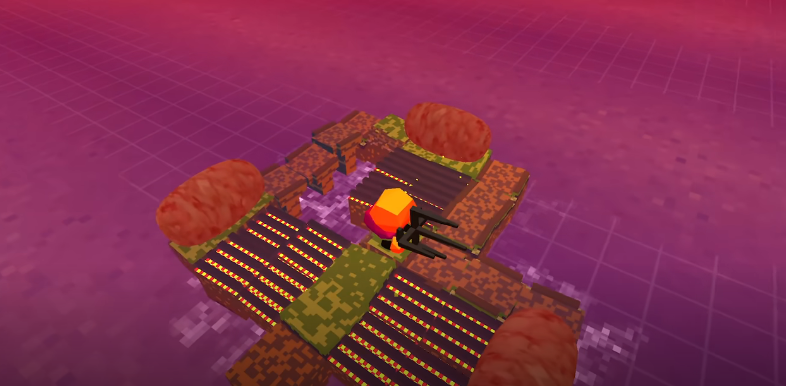
I found increpare by way of his infamous sokoban release Stephen’s Sausage Roll (2016), a lauded puzzler about rotating and grilling sausages one side at a time whose eventual complexity came to strike me devious and perhaps even profoundly evil. That a developer could conceptualize so many methods and rules for incremental, grid-based manipulation of bratwurst--or is it salami, chorizo, andouille?--and then actually go on to design interactive environments which tested a player’s anticipation of and understanding of those tactics left me with a real vertigo toward the subgenre. (Sokoban games are, loosely, about pushing blocks around, but the devil's in the details). There are epiphanies of rotation and parity to be seized in SSR that will make you feel like you’re assembling a grandfather clock, in the dark, with telekinesis. Its somber orange expanses continue to mesmerize me in large part because of the game’s mechanical spareness: level grids are simple enough that I found myself conceptualizing and solving a few of them while miles away from my computer, and since the core inputs don’t ever change, many of those solutions were epiphanic in a primal sense: I could have done this all along.
In retrospect, SSR does seem like the spark that set fire to the loose sokoban revival in the more traditional indie publishing sphere formed by the likes of Baba is You (2019), Monster’s Expedition (2020), Patrick’s Parabox (2022), and Void Stranger (2023), among others. Increpare meanwhile set his sights elsewhere. While many of the subsequent 256 titles he churned out post-Sausage were, indeed, charming sokoban-y PuzzleScript cobblings, his latest major release is a three-dimensional platformer called Oeuf, and in my mind, his next overt masterpiece.
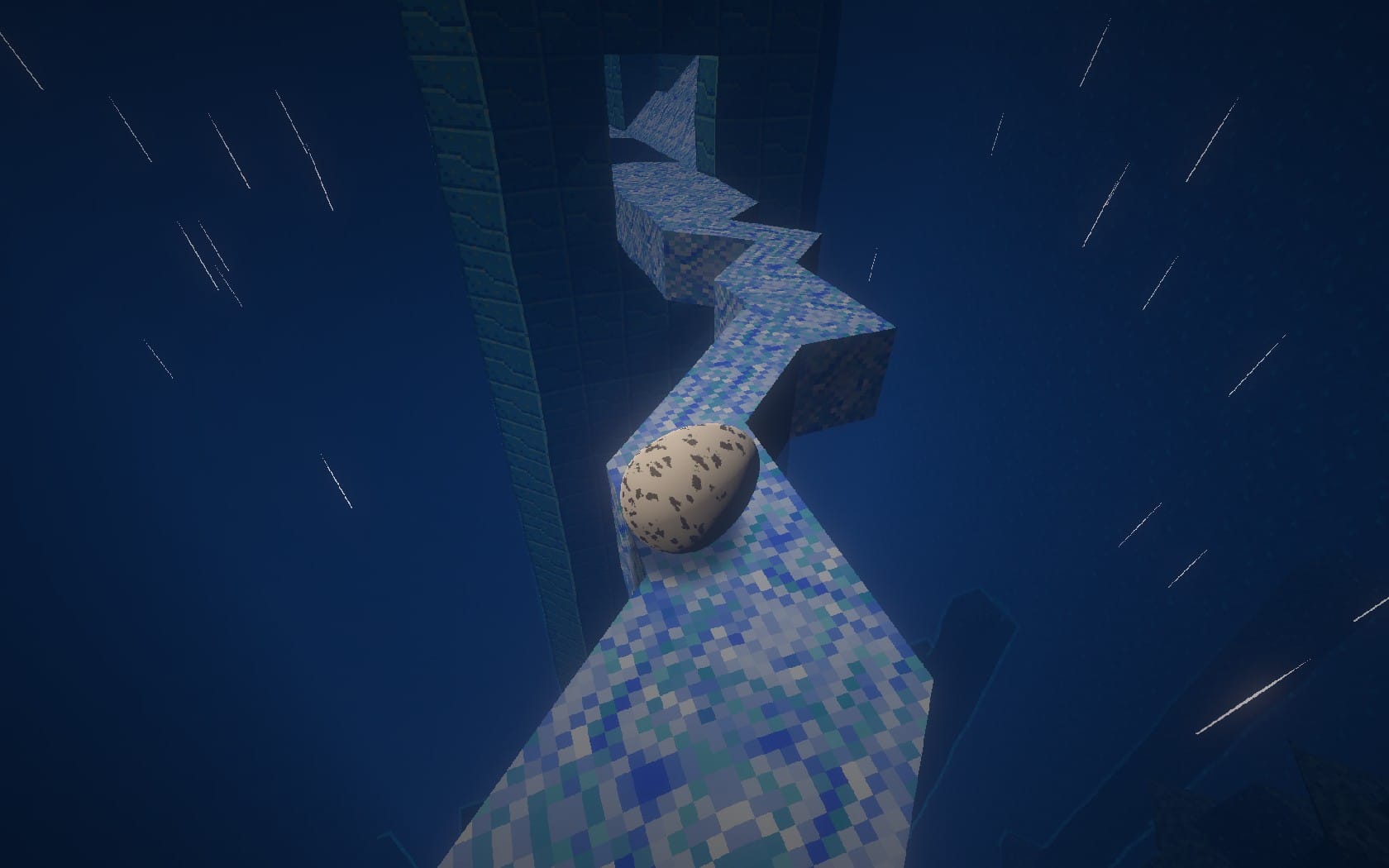
Oeuf--”egg” en français, and also the surreal “oof!” your avian shell lets out upon breaking--is a deeply tactile game which does for real-time wobbling ovoids what Sausage did for turn-based cylindrical roasts: explodes, in nuclear terms, the possibility space of a comparatively simple set of mechanics which are constantly recontextualized but never expanded upon. In this case, Oeuf’s egg can only ever 1) roll and 2) jump. Less reductively: the roll is bound by the ways in which a fuller base and narrower tip considerably inform one’s direction, momentum, center but also direction of rotation, and weight distribution; the jump is considerably informed by such delicious, multitudinous qualities of the roll.
Initially, I considered how difficult it was for something so round to remain completely still on these surfaces, which--to anyone’s surprise given the well-worn premise--are found to be exclusively flat (but often canted) and exclusively motionless (but often mean). No quarterpipes or moving platforms here. Initially, I found myself thinking of the pitch/yaw which define an aircraft’s orientation along lateral/longitudinal axes, given the novel necessity of keen attention to one’s mid-air and mid-roll positioning. Oeuf is an emphatically three-dimensional game. Oeuf has no platformerly interest in disguising its playing space, in unseen hitbox-y vectors abutting each other, locking perpendicularly, rotely: its fascination is with the sheer variety of difference beholden to wobbly, parabolic movement, with the precise arrangement, in limitless space, of a series of abstract planes, always at delectable odds. How appropriate that its fixed rectilinear world of tilted surfaces might be navigated by the one thing that is round, the one thing that moves, the one thing that lives.
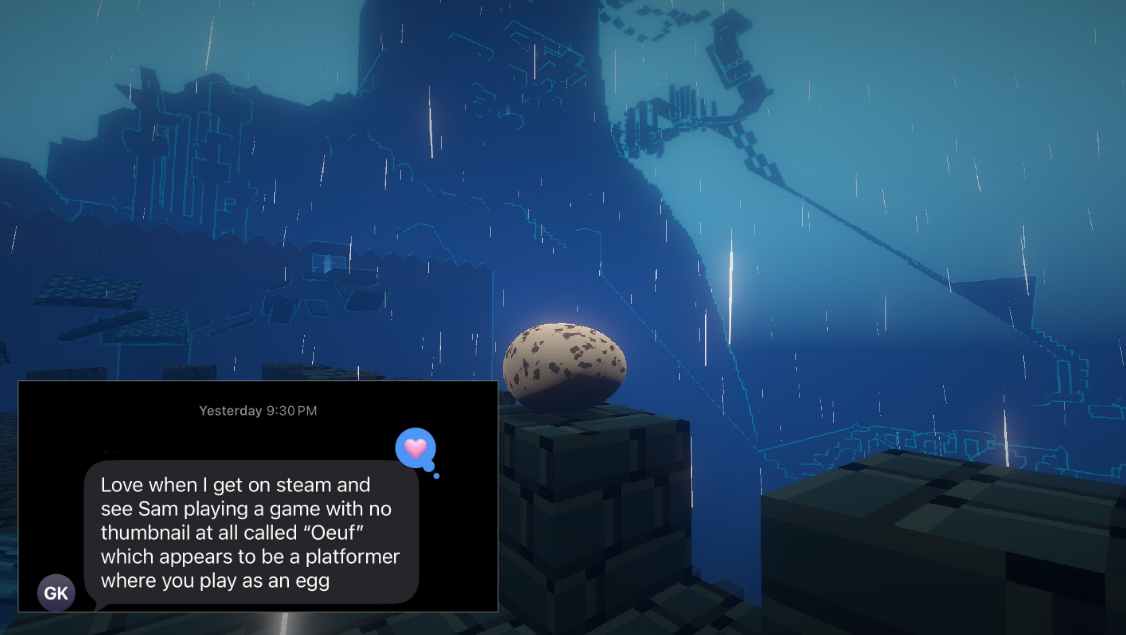
The Oeuf aficionado will quickly develop an abnormally intimate understanding of their imperfect vessel’s weight distribution, as if operating from inside it all along, passing signals within this sub-reality from the outside world, pressing always against, aloof, responsible for the bouncing action which alone renders its physics as strange, unlifelike. (Nota bene: evolutionarily, eggs are shaped as such in part to prevent a-rolling-away). Pivoting around hairpin corners in this feudal expanse is possible, of course, eventually mandated, since the tip can lean out over the abyss due to the off-kilter center of mass. It’s easier to accelerate while rolling on one side, of course, than with a more pigskinly, top-down trip-up. The yolk only shows during the failure state. Of course. Is Oeuf the anti-Monkey Ball or -Marble Blast, the righteous cerebral follow-up to the orbly likes of a Kula World or Katamari? Of course. If anyone in this medium actually knew ball, the fact that this $9.99 platformer was playtested by the likes of Terry Cavanaugh and Bennett Foddy would turn heads by itself. Its ponderous system of movement, like theirs, reminds me that platforming games’ jump states are typically non-variable, or, provide an identical result every time you press the button, or, are boring, easy, and lame. Rolling towards the most banal of precipitous gaps, in contrast, an Oeuf-er might come to sense, in the extremities used to tilt and roll the onscreen ovoid, the slightest resistances and heft, might even begin to welcome the game’s fundamental challenges, which are composed of contact-point-dependent swivels, careens, and leaps whose failure states are severe. (Checkpoints are like chapter breaks, appropriately themed and appropriately distant.) By the late-game, the player-as-ovum will have ex-internalized maneuvers which have not been so much tested incrementally at linear intervals as subsumed: acquired quadratically. Graded on a curve. They will at this point find their own thumbs executing impromptu onscreen roll-jump maneuvers which can literally only be described as balletic: a face-first dash towards a precipitous poise, a calculated spring into the air by which the bottom traces an elegant, somersaulting arc over the top. Bringing the egg to a sudden halt, one becomes quite dancerly attuned, always-already, to the direction in which it will lean, tilt, pirouette. Surely the thumb-brain apparatus I use to navigate these rolling fields of polygons is contained literally within the egg, given how strongly I feel as if I’m running my own fingers along the manmade and natural surfaces of the game’s interconnected world? My shell’s (simulated) texture boasts a sensibly high friction. Of course.
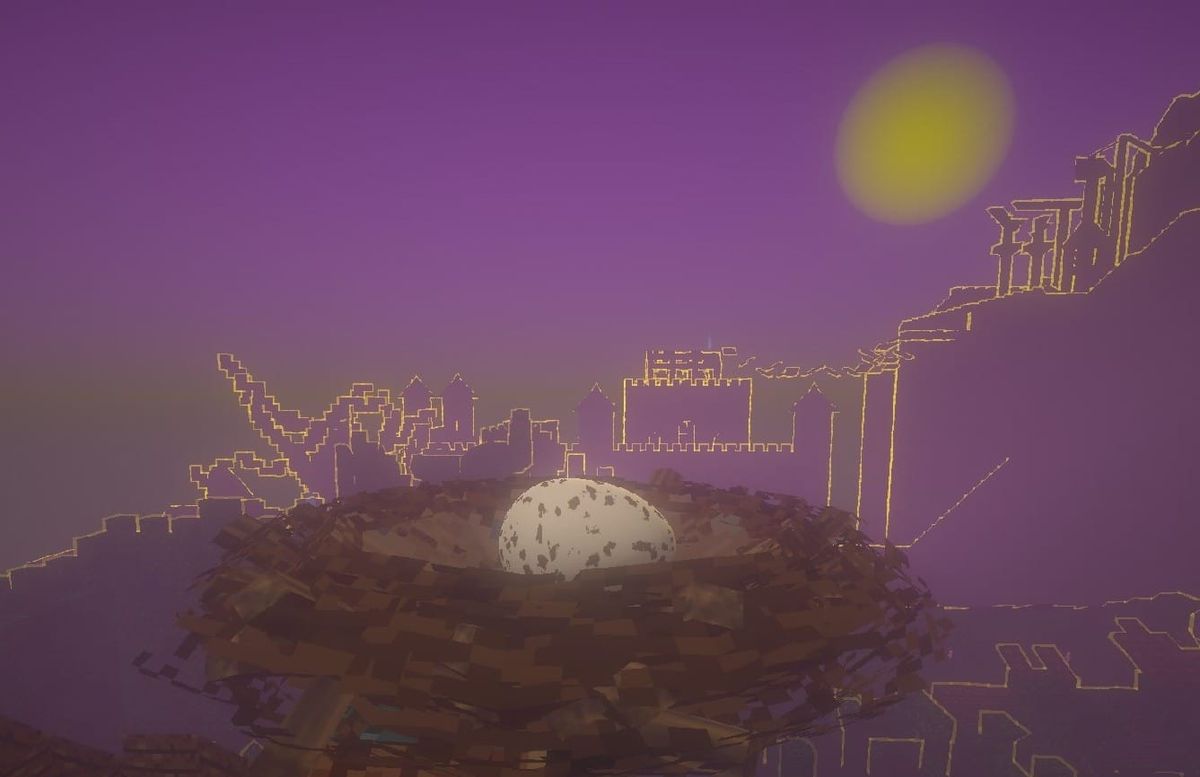
Its modest mottling suggests a sparrow, or maybe a meadowlark. A tern. Blown out of its nest into the village below, the game begins in proper with a light wind. The yolk--the yoke--of control is given to the player at this point and never once rescinded. It’s satisfying to play any game in which everything superfluous has already been omitted; it’s satisfying to purchase, with currency and goodwill, the product of an artist whose work is so defiantly and endlessly unbound by stale market trends; it’s satisfying to come across a proper 3D platformer outside of those rabidly anti-art Nintendo corporate offices; it’s satisfying to explore a virtual place which has been stripped of the toddlery handholding, ludic interruptions, and non-diegesis in which they’ve come to specialize (read: profitize). Only rain falls softly, here. For several nights I play the game greedily, feasting on its uncanny carpentry, its simplistic rock faces, the graveyard's walls and the iced cloudscapes, its dual delight in the sublime within the mundane. Ambient melodies recall the early, pre-Microsoft days of a selfsame world of such low-res, blocky textures. My egg’s treacherous ascent is possibly a return home, possibly something else--an imagistic movement through human dreamscapes, beyond mossy palace walls, brick chimneys, purple stalactites--but what’s most resonant is the sheer purity of the experience, that it shirks timers, health, collectibles, level divisions, and enemies in favor of building and maintaining this immersive sense of place which lives in my mind like a proper painting, a novella, a soufflé. When I beat Oeuf, I am back at my own nest, grinning; I am back at the main menu, grinning. I begin again, right away. Again. An egg ceases to be an egg once it hatches. Other developers--other artists--other people--could do well to confine themselves likewise. Of course.